Speech by The Honourable John G. Roberts, Jr.
Chief Justice of the United States on his Call as an Honorary Bencher to The Honourable Society of the Middle Temple
Thursday, 19 July 2007
“You heard from the Treasurer about this new book that is out, which I also recommend, on our Middle Temple by Justice Holland and Eric Stockdale. It was about a year ago that Justice Holland gave me the manuscript of the book, and I assured him I would lose no time reading it — but I did read it!
And, in fact, with Lord Phillips, I wrote an introduction to it, and learned a great deal about the Middle Temple and the connections between the spread of the rule of law in the new United States and the members of this Middle Temple. I also learned of their founding of Jamestown in 1607, which brought the English way of life and the English legal traditions to America. And, as I said in April, the place hasn’t been the same since!
Seriously, we in America at our founding had the great good fortune to be an heir of the great British legal system.”
FULL SPEECH
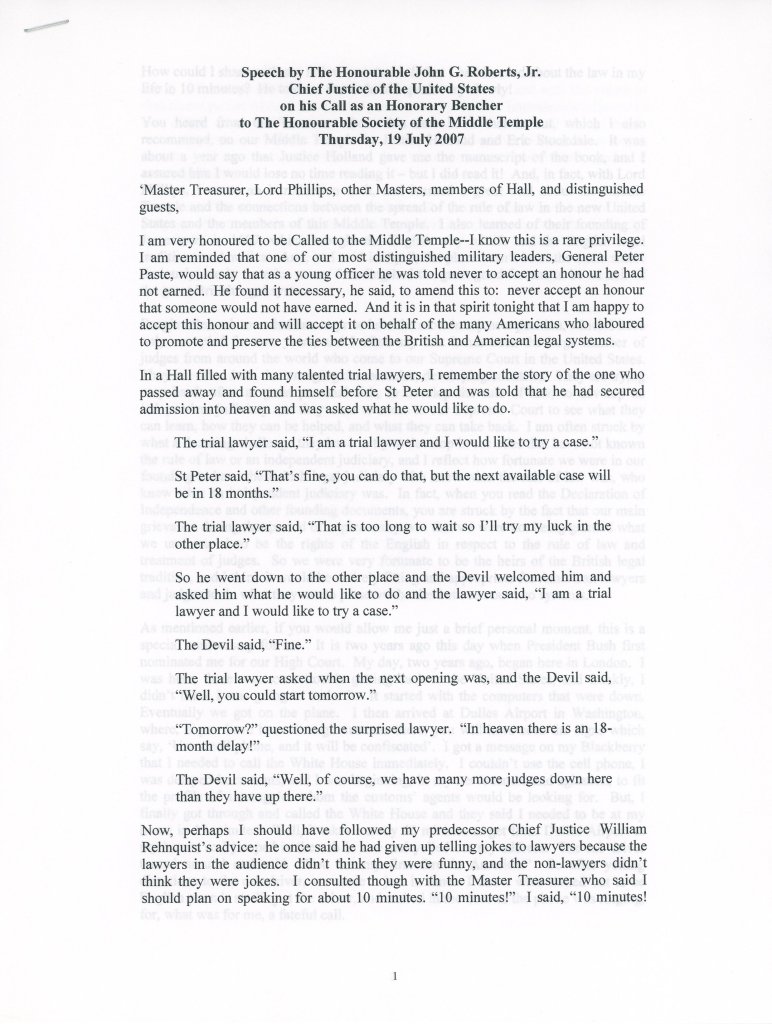
Speech by The Honourable John G. Roberts, Jr.
Chief Justice of the United States on his Call as an Honorary Bencher to The Honourable Society of the Middle Temple
Thursday, 19 July 2007
‘Master Treasurer, Lord Phillips, other Masters, members of Hall, and distinguished guests,
I am very honoured to be Called to the Middle Temple—I know this is a rare privilege. I am reminded of one of our most distinguished military leaders, General Peter Paste. He would say that as a young officer, he was told never to accept an honour he had not earned. He found it necessary to amend this to: never accept an honour that someone would not have earned. It is in that spirit tonight that I am happy to accept this honour and will do so on behalf of the many Americans who laboured to promote and preserve the ties between the British and American legal systems.
In a Hall filled with many talented trial lawyers, I remember the story of one who passed away and found himself before St Peter. He was told that he had secured admission into heaven and was asked what he would like to do.
The trial lawyer responded, “I am a trial lawyer and I would like to try a case.”
St Peter said, “That’s fine, you can do that, but the next available case will be in 18 months.”
Dismayed by the delay, the trial lawyer decided to try his luck in the other place, where the Devil welcomed him and asked him what he would like to do. When he expressed his wish to try a case, the Devil immediately agreed, stating he could start the very next day.
“Tomorrow?” questioned the surprised lawyer. “In heaven, there is an 18-month delay!”
The Devil chuckled, “Well, of course, we have many more judges down here than they have up there.”
Perhaps I should have heeded my predecessor Chief Justice William Rehnquist’s advice: he once mentioned he had given up telling jokes to lawyers because the lawyers in the audience didn’t think they were funny, and the non-lawyers didn’t think they were jokes. However, I consulted with the Master Treasurer who advised I should plan on speaking for about 10 minutes. “10 minutes!” I exclaimed, “10 minutes!”
“How could I share with my fellow members all that I had learned about the law in my life in just 10 minutes?” I wondered. He told me that I should speak very slowly!
You heard from the Treasurer about this new book that is out, which I also recommend, on our Middle Temple by Justice Holland and Eric Stockdale. It was about a year ago that Justice Holland gave me the manuscript of the book, and I assured him I would lose no time reading it — but I did read it! And, in fact, with Lord Phillips, I wrote an introduction to it. I learned a great deal about the Middle Temple and the connections between the spread of the rule of law in the new United States and the members of this Middle Temple. I also discovered their role in the founding of Jamestown in 1607, which brought the English way of life and the English legal traditions to America. As I said in April, the place hasn’t been the same since! Seriously, we in America at our founding had the great good fortune to be an heir of the great British legal system.
People often ask me what has surprised me the most in my new position, which I have only occupied for two years, and I often say that it has been the large number of judges from around the world who come to our Supreme Court in the United States. They are often from emerging democracies, developing countries, trying very hard, often at great personal risk, to develop the rule of law, to foster an independent judiciary. They seek to learn from our Supreme Court, to see how they can be helped, and what they can take back. I am often struck by the daunting challenge they face trying to instil the rule of law and an independent judiciary in societies that have not known them, and I reflect on how fortunate we were in our founding to have the British legal judiciary, who understood what the rule of law and an independent judiciary were.
In fact, when you read the Declaration of Independence and other founding documents, you realize that our main grievance during that period of discord was that we were not being granted what we understood to be the rights of the English in respect to the rule of law and treatment of judges. We were fortunate to be the heirs of the British legal tradition, and it would be entirely fitting and appropriate for American lawyers and judges to preserve the ties between our two systems.
If you would allow me just a brief personal moment, this is a special anniversary for me. It is two years ago this day when President Bush first nominated me for our High Court. My day, two years ago, began here in London. There was trouble getting back to the United States, and frankly, I didn’t think I was going to make it. After overcoming numerous obstacles and challenges, including a hurried cab ride with a driver new to America, I made it just in time. I threw what turned out to be English pounds sterling at the driver and rushed in the door as the phone was ringing, for what was, for me, a fateful call.
But, I will always associate that day, of course, with this city and with the events of that recent period where I was teaching at University College, immediately adjacent to one of the areas that was bombed by terrorist attacks. There will always be an association in my mind not only with my responsibilities that in some sense began that day, but also with the consequences that we face when the rule of law is challenged, as it was here at that time.
I am also often asked, after my short period on the Bench, what I have learned about judging. What I have learned about judging is that it is exactly the way the first judge I worked for, Judge Henry Friendly of the Court of Appeals for the Second Circuit, described, and he used a metaphor from England. He said, “Judging is very much like the way that villagers in an English village will try and guess the weight of a hog. They would get a beam and balance it on a rock. They would place the hog on one end of the beam and they would load stones on the other end of the beam until it was perfectly balanced. Then they would try and guess the weight of the stones.” So that is what I have learned about judging.
I have had a marvelous tour of this amazing building and I am delighted to help open the new facility up in the attic, and I am very, very honored to become a Master in this very special place. Thank you very much.


 Justice Randy J. Holland Memorial