-
Letter from Justice Ruth Bader Ginsburg re Inns of Court – August 7, 2000
CHAMBERS OF JUSTICE RUTH BADER GINSBURG
Supreme Court of the United States
Washington, D. C. 20543August 7, 2000
The Honorable Randy J. Holland
Supreme Court of DelawareP.O. Box 369
Georgetown, Delaware 19947Dear Justice Holland:
Cheers on becoming President of the American Inns of Court Foundation. May you thrive in this challenging post.
With every best wish for your tenure,
Ruth Bader Ginsburg Categories: Justice GinsburgTags: 2000, august, delaware, innsofcourt, judge, judicial, judiciary, justiceginsburg, law, lawyer, legal, Letters, note, notoriousrbg, randyholland, randyjolland, rbg, ruthbaderginsburg, ruthginsburg, scotus, supremecourt
 -
Letter from Randy Holland to Justice Lewis Powell re Inns of Court – November 12, 1993
RANDY J. HOLLAND
JUSTICE SUPREME COURT OF DELAWARE
November 12, 1993P.O. Box 369
GEORGETOWN, DELAWARE 19947Justice Lewis F. Powell, Jr.
United States Supreme Court, retired
1 First Street, N.E.
Washington, DC 20543Dear Justice Powell,
It was an honor to meet you and your wife last Saturday at dinner. The American Inns of Court Award for Professionalism and Ethics could not have a more appropriate namesake. You are the personification of the principles that the American Inns of Court seeks to perpetuate: legal excellence, ethics, civility and professionalism.
As I told you, your written opinions and judicial demeanor set a standard to which all jurists should aspire. Thank you for supporting the American Inns’ of Court.
Respectfully yours,
RandyRJH/mkp
 Tags: 1993, delaware, innsofcourt, judge, judicial, judiciary, justicepowell, law, lawyer, legal, Letters, lewispowell, note, november, randyholland, randyjolland, scotus, supremecourt
 -
Letter from Justice Lewis Powell to Randy J. Holland re Inns of Court – November 16, 1993
Supreme Court of the United States
Washington, D. C. 20543
CHAMBERS OF JUSTICE LEWIS F. POWELL, JR. RETIREDNovember 16, 1993
Dear Randy:
Your letter of November 12, is one that I will keep. We enjoyed meeting you at the dinner of the American Inns of Court. The objectives of the Inns that you outline in your letter are the ones that should be perpetuated.I send warm best wishes.
Sincerely,
LewisHon. Randy J. Holland
Justice
Supreme Court of Delaware
P. O. Box 369
Georgetown, Delaware 19947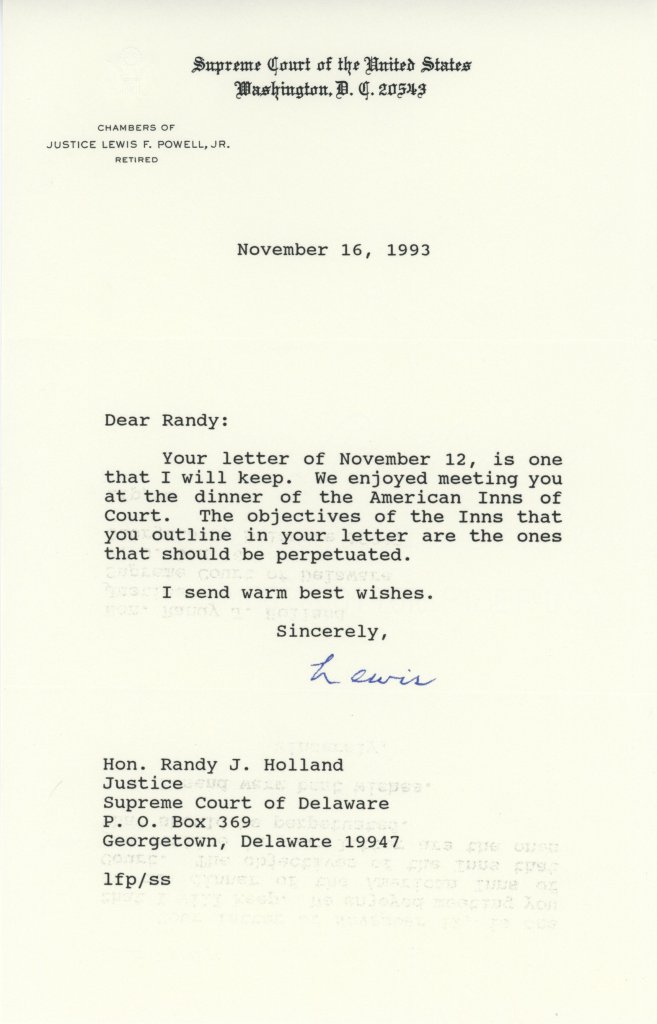 Categories: US Supreme Court JusticesTags: 1993, delaware, innsofcourt, judge, judicial, judiciary, justicepowell, law, lawyer, legal, Letters, lewispowell, note, november, randyholland, randyjolland, scotus, supremecourt
 -
Speech by The Honourable John G. Roberts, Jr. re Honorary Bencher to the Middle Temple July 9, 2007
Speech by The Honourable John G. Roberts, Jr.
Chief Justice of the United States on his Call as an Honorary Bencher to The Honourable Society of the Middle Temple
Thursday, 19 July 2007“You heard from the Treasurer about this new book that is out, which I also recommend, on our Middle Temple by Justice Holland and Eric Stockdale. It was about a year ago that Justice Holland gave me the manuscript of the book, and I assured him I would lose no time reading it — but I did read it!
And, in fact, with Lord Phillips, I wrote an introduction to it, and learned a great deal about the Middle Temple and the connections between the spread of the rule of law in the new United States and the members of this Middle Temple. I also learned of their founding of Jamestown in 1607, which brought the English way of life and the English legal traditions to America. And, as I said in April, the place hasn’t been the same since!
Seriously, we in America at our founding had the great good fortune to be an heir of the great British legal system.”
FULL SPEECH
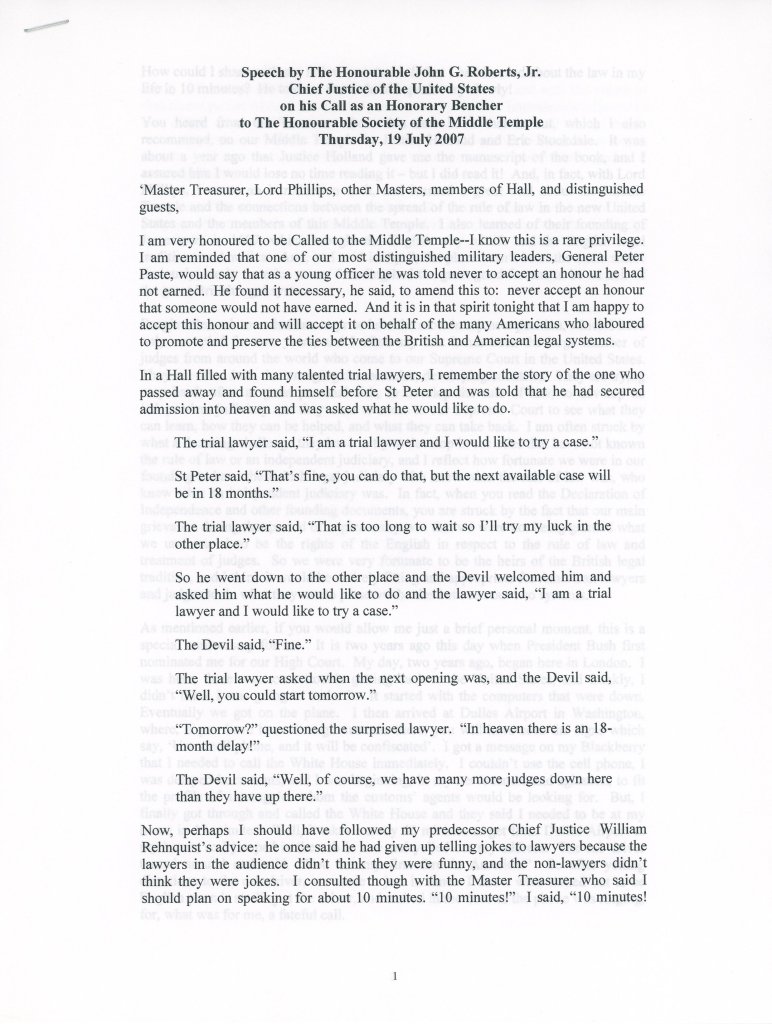
Speech by The Honourable John G. Roberts, Jr.
Chief Justice of the United States on his Call as an Honorary Bencher to The Honourable Society of the Middle Temple
Thursday, 19 July 2007
‘Master Treasurer, Lord Phillips, other Masters, members of Hall, and distinguished guests,
I am very honoured to be Called to the Middle Temple—I know this is a rare privilege. I am reminded of one of our most distinguished military leaders, General Peter Paste. He would say that as a young officer, he was told never to accept an honour he had not earned. He found it necessary to amend this to: never accept an honour that someone would not have earned. It is in that spirit tonight that I am happy to accept this honour and will do so on behalf of the many Americans who laboured to promote and preserve the ties between the British and American legal systems.
In a Hall filled with many talented trial lawyers, I remember the story of one who passed away and found himself before St Peter. He was told that he had secured admission into heaven and was asked what he would like to do.
The trial lawyer responded, “I am a trial lawyer and I would like to try a case.”
St Peter said, “That’s fine, you can do that, but the next available case will be in 18 months.”
Dismayed by the delay, the trial lawyer decided to try his luck in the other place, where the Devil welcomed him and asked him what he would like to do. When he expressed his wish to try a case, the Devil immediately agreed, stating he could start the very next day.
“Tomorrow?” questioned the surprised lawyer. “In heaven, there is an 18-month delay!”
The Devil chuckled, “Well, of course, we have many more judges down here than they have up there.”
Perhaps I should have heeded my predecessor Chief Justice William Rehnquist’s advice: he once mentioned he had given up telling jokes to lawyers because the lawyers in the audience didn’t think they were funny, and the non-lawyers didn’t think they were jokes. However, I consulted with the Master Treasurer who advised I should plan on speaking for about 10 minutes. “10 minutes!” I exclaimed, “10 minutes!”
“How could I share with my fellow members all that I had learned about the law in my life in just 10 minutes?” I wondered. He told me that I should speak very slowly!
You heard from the Treasurer about this new book that is out, which I also recommend, on our Middle Temple by Justice Holland and Eric Stockdale. It was about a year ago that Justice Holland gave me the manuscript of the book, and I assured him I would lose no time reading it — but I did read it! And, in fact, with Lord Phillips, I wrote an introduction to it. I learned a great deal about the Middle Temple and the connections between the spread of the rule of law in the new United States and the members of this Middle Temple. I also discovered their role in the founding of Jamestown in 1607, which brought the English way of life and the English legal traditions to America. As I said in April, the place hasn’t been the same since! Seriously, we in America at our founding had the great good fortune to be an heir of the great British legal system.
People often ask me what has surprised me the most in my new position, which I have only occupied for two years, and I often say that it has been the large number of judges from around the world who come to our Supreme Court in the United States. They are often from emerging democracies, developing countries, trying very hard, often at great personal risk, to develop the rule of law, to foster an independent judiciary. They seek to learn from our Supreme Court, to see how they can be helped, and what they can take back. I am often struck by the daunting challenge they face trying to instil the rule of law and an independent judiciary in societies that have not known them, and I reflect on how fortunate we were in our founding to have the British legal judiciary, who understood what the rule of law and an independent judiciary were.
In fact, when you read the Declaration of Independence and other founding documents, you realize that our main grievance during that period of discord was that we were not being granted what we understood to be the rights of the English in respect to the rule of law and treatment of judges. We were fortunate to be the heirs of the British legal tradition, and it would be entirely fitting and appropriate for American lawyers and judges to preserve the ties between our two systems.
If you would allow me just a brief personal moment, this is a special anniversary for me. It is two years ago this day when President Bush first nominated me for our High Court. My day, two years ago, began here in London. There was trouble getting back to the United States, and frankly, I didn’t think I was going to make it. After overcoming numerous obstacles and challenges, including a hurried cab ride with a driver new to America, I made it just in time. I threw what turned out to be English pounds sterling at the driver and rushed in the door as the phone was ringing, for what was, for me, a fateful call.
But, I will always associate that day, of course, with this city and with the events of that recent period where I was teaching at University College, immediately adjacent to one of the areas that was bombed by terrorist attacks. There will always be an association in my mind not only with my responsibilities that in some sense began that day, but also with the consequences that we face when the rule of law is challenged, as it was here at that time.
I am also often asked, after my short period on the Bench, what I have learned about judging. What I have learned about judging is that it is exactly the way the first judge I worked for, Judge Henry Friendly of the Court of Appeals for the Second Circuit, described, and he used a metaphor from England. He said, “Judging is very much like the way that villagers in an English village will try and guess the weight of a hog. They would get a beam and balance it on a rock. They would place the hog on one end of the beam and they would load stones on the other end of the beam until it was perfectly balanced. Then they would try and guess the weight of the stones.” So that is what I have learned about judging.
I have had a marvelous tour of this amazing building and I am delighted to help open the new facility up in the attic, and I am very, very honored to become a Master in this very special place. Thank you very much.

 Categories: booksTags: AmericanLegalSystem, BritishLegalSystem, delaware, HonourAndPrivilege, IndependentJudiciary, InsightsOnJudging, johnroberts, judge, judicial, JudicialInsight, judiciary, justiceroberts, law, lawyer, legal, LegalConnection, LegalHeritage, LegalTradition, LegalWisdom, Letters, middletemple, note, randyholland, randyjolland, ruleoflaw, scotus, supremecourt, USUKLegalTies
 -
Chief Justice John Roberts: Signed Copy of Middle Temple Lawyers and the American Revolution
MIDDLE TEMPLE LAWYERS AND THE AMERICAN REVOLUTION
By His Honour Eric Stockdale and Justice Randy J. HollandSigned by Chief Justice John Roberts
For Randy Holland,
With appreciation for me to be associated with such a fine book!
John Roberts Jr.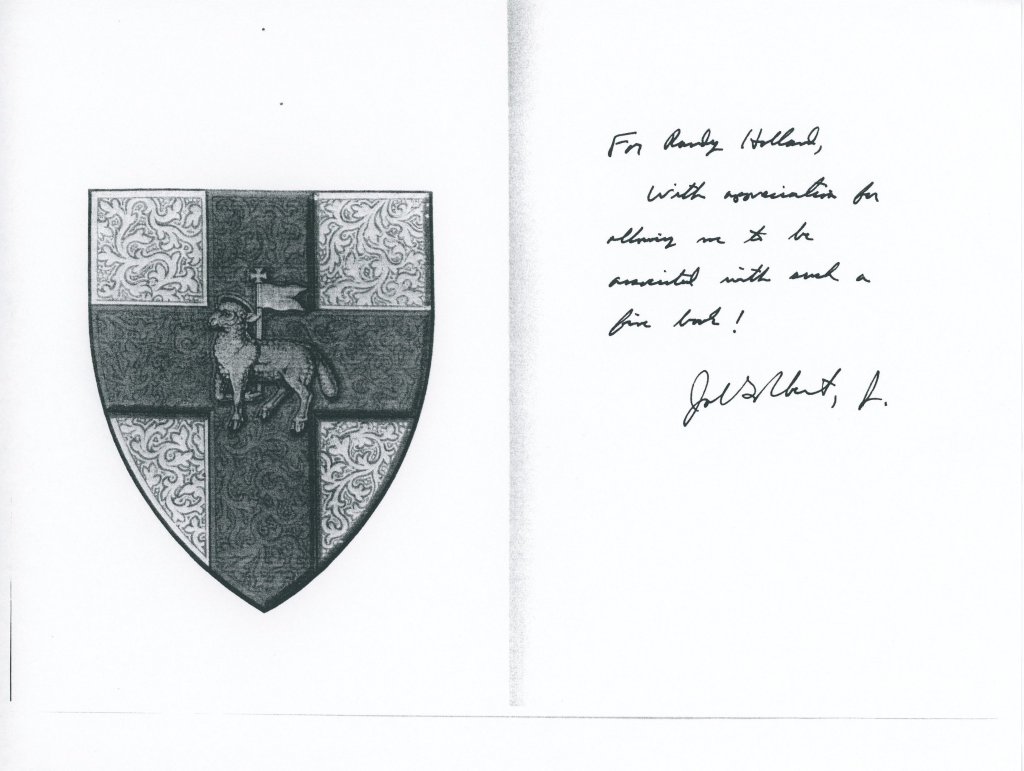 Categories: booksTags: American History, American Revolution, Chief Justice Of The United States, Chief Justice USA, Colonial History, Colonists, Dickinson, English Common Law, Englishmen Rights, Eric Stockdale, Forewords, His Honour, Historical Influence, Individual Rights, Influence, John G Roberts, Law And Society, Law Education, Legal History, Legal Influence, Legal Scholarship, London Government, Lord Chief Justice, Lord Chief Justice Of England And Wales, lord phillips, middle temple, Pinckney, Randy J Holland, Reed, Rutledge, Scholarly Work, State Constitutions, Taxation, Taxation Without Representation, The Honorable, The Rt Hon, Unrepresented Colonists, US Constitution
 -
Press Release: Middle Temple Lawyers and the American Revolution
MIDDLE TEMPLE LAWYERS AND THE AMERICAN REVOLUTION
By His Honour Eric Stockdale and Justice Randy J. HollandFOREWORDS BY
The Rt. Hon. The Lord Phillips of Worth Matravers, Lord Chief Justice of England and Wales and The Honorable John G. Roberts, Jr., Chief Justice of the United StatesIlluminates the influence of the Middle Temple and its members on American history
Many readers will be aware of the fact that American law is based on the English common law, and will have appreciated that it was brought with them by the first settlers. They will also know that some of the descendants of those settlers came to England in the eighteenth century to learn law and returned with a clear understanding of their rights as Englishmen, despite living in the American colonies. When the London government attempted to tax the unrepresented colonists, many of the protests came from lawyers, a large proportion of whom had attended the
Middle Temple in London for an important stage of their education. What may come as a surprise to many readers, is just how important the contribution of those Middle Templars was, not only to the resultant Revolution itself, but to the later discussions leading to the individual state constitutions as well as the United States Constitution. They may also be interested to see how often the names of some of the most distinguished of those American members of the Middle Temple come up in the history of the infant United States, especially the names Dickinson, Reed, Rutledge and Pinckney.“Members of the Inn will be delighted with this scholarly work, which brings the threads of our history together, but it will surely appeal also to any with an interest in American history for the new light that it throws on familiar events.”
-The Rt. Hon. The Lord Phillips of Worth Matravers, Lord Chief Justice of England and Wales“Readers will come away with a deeper appreciation of the character of the Nation’s leading colonial lawyers, the role of English legal education in their lives, and the influence of the Middle Temple in shaping American institutions.”
-The Honorable John G. Roberts, Jr., Chief Justice of the United States Categories: booksTags: American History, American Revolution, Chief Justice Of The United States, Chief Justice USA, Colonial History, Colonists, delaware, Dickinson, English Common Law, Englishmen Rights, Eric Stockdale, Forewords, His Honour, Historical Influence, Individual Rights, Influence, John G Roberts, johnroberts, judge, judiciary, justiceroberts, law, Law And Society, Law Education, lawyer, legal, Legal History, Legal Influence, Legal Scholarship, Letters, London Government, Lord Chief Justice, Lord Chief Justice Of England And Wales, lord phillips, middle temple, note, Pinckney, Randy J Holland, randyholland, Reed, Rutledge, Scholarly Work, scotus, State Constitutions, supremecourt, Taxation, Taxation Without Representation, The Honorable, The Rt Hon, Unrepresented Colonists, US Constitution
 -
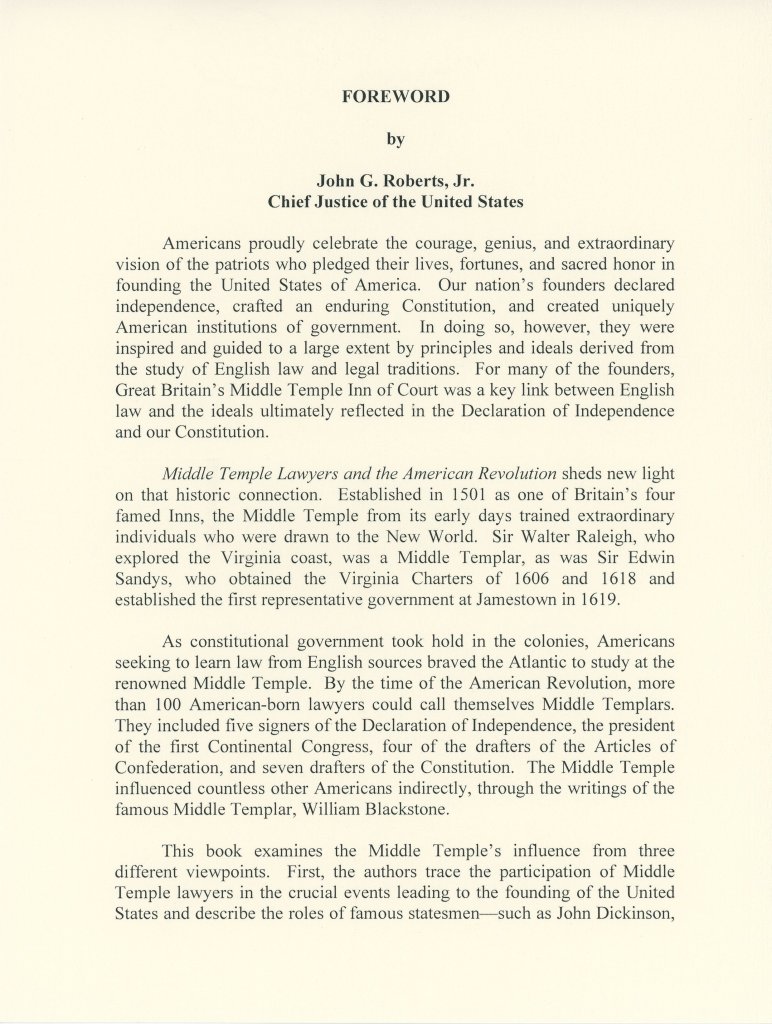
Forward by Justice John Roberts for Middle Temple and the American Revolution Book
“Middle Temple Lawyers and the American Revolution”
by Randy J. Holland and Eric Stockdale
Forward by
John G. Roberts, Jr.
Chief Justice of the United States
Americans proudly celebrate the courage, genius, and extraordinary vision of the patriots who pledged their lives, fortunes, and sacred honor in founding the United States of America. Our nation’s founders declared independence, crafted an enduring Constitution, and created uniquely American institutions of government. In doing so, however, they were inspired and guided to a large extent by principles and ideals derived from the study of English law and legal traditions. For many of the founders, Great Britain’s Middle Temple Inn of Court was a key link between English law and the ideals ultimately reflected in the Declaration of Independence and our Constitution.
Middle Temple Lawyers and the American Revolution sheds new light on that historic connection. Established in 1501 as one of Britain’s four famed Inns, the Middle Temple from its early days trained extraordinary individuals who were drawn to the New World. Sir Walter Raleigh, who explored the Virginia coast, was a Middle Templar, as was Sir Edwin Sandys, who obtained the Virginia Charters of 1606 and 1618 and established the first representative government at Jamestown in 1619.
As constitutional government took hold in the colonies, Americans seeking to learn law from English sources braved the Atlantic to study at the renowned Middle Temple. By the time of the American Revolution, more than 100 American-born lawyers could call themselves Middle Templars. They included five signers of the Declaration of Independence, the president of the first Continental Congress, four of the drafters of the Articles of Confederation, and seven drafters of the Constitution. The Middle Temple influenced countless other Americans indirectly, through the writings of the famous Middle Templar, William Blackstone.
This book examines the Middle Temple’s influence from three different viewpoints. First, the authors trace the participation of Middle Temple lawyers in the crucial events leading to the founding of the United States and describe the roles of famous statesmen-such as John Dickinson, John and Edward Rutledge, Peyton Randolph, and Charles Pinckney-who applied their legal skills to the cause of independence. Next, the authors examine the formative Middle Temple experiences of the American colonists who traveled to London and took up study at the Inn. That examination, drawn from the transoceanic correspondence between the young Templars and their anxious parents, offers personal and often humorous insights into the legal and social education of America’s first statesmen. Finally, the authors set out biographical sketches of some of the prominent colonial families such as the Lees, Randolphs, Rutledges, and Pinckneys who benefited from the Middle Temple education.
Middle Temple Lawyers and the American Revolution provides a new perspective, both entertaining and scholarly, on the remarkable early American lawyers who drew upon both their London training and their colonial experience to launch the ongoing American experiment in representative government under the rule of law. Readers will come away with a deeper appreciation of the character of the Nation’s leading colonial lawyers, the role of English legal education in their lives, and the influence of the Middle Temple in shaping American institutions.
 Tags: americans, blackstone, book, continentalcongress, delaware, ericstockdale, forward, founders, government, greatbritain, innsofcourt, johnroberts, judge, judicial, judiciary, justiceroberts, law, lawyer, legal, Letters, middletemple, note, randyholland, revolution, scotus, siredwinsandys, sirwalterraleigh, supremecourt
 -
Letter from Chief Justice John Roberts to Randy J. Holland re 30 years on the bench– October 27, 2016
CHAMBERS OF THE CHIEF JUSTICE
Supreme Court of the United States Washington, D. C. 20543October 27, 2016
The Honorable Randy J. Holland
Associate Justice
Supreme Court of Delaware
405 N. King Street, Suite 509 Wilmington, Delaware 19801Dear Randy,
Congratulations on reaching the milestone of 30 years of service as a Justice of the First State. With your appointment in 1986, you became the youngest person to serve on the Delaware Supreme Court. This year you become the youngest person to complete three decades of service on that bench.
Through these years, you have made important contributions as a jurist, scholar, and teacher. I thank you for your past service as a member of the Judicial Conference’s Advisory Committee on Appellate Rules and your ongoing efforts to promote the rule of law here and abroad.
Sincerely,
John Roberts Jr. Categories: John RobertsTags: 1986, 2016, 30years, congratulations, delaware, johnroberts, judge, judicial, judiciary, jurist, justiceroberts, law, lawyer, legal, Letters, note, october, randyholland, scholar, scotus, supremecourt, teacher, youngest
 -
Message from Chief Justice John Roberts to Randy J. Holland re Justice Lewis F. Powell, Jr. Award for Professionalism and Ethics– September 17, 2014
COUNSELOR TO THE CHIEF JUSTICE
September 17, 2014
Supreme Court of the United States
Washington, D. C. 20543The Honorable Randy J. Holland
Justice
Delaware Supreme Court
Court of Chancery Courthouse P. O. Box 369
Georgetown, Delaware 19947Dear Justice Holland:
The Chief Justice received your August 25, 2014, letter inviting him and Mrs. Roberts to the American Inns of Court Celebration of Excellence on October 25, 2014. He appreciates your kind invitation and asked me to respond on his behalf. Unfortunately, the press of judicial business at the beginning of the Term prevents the Chief Justice from attending. Although his is unable to join you for this special event, he is pleased to know that the American Inns of Court has been so discerning in its recognitions this year.
Congratulations on your selection to receive the Justice Lewis F. Powell, Jr., Award for Professionalism and Ethics. The honor reflects not only a distinguished career of dedicated service, but also your continuing efforts to model the profession’s greatest virtues.
Best wishes for a rewarding evening. I look forward to seeing you there.
Sincerely,
Jeff
Jeffrey P. Minear Categories: John RobertsTags: 2014, american, award, counselor, delaware, ethics, innsofcourt, johnroberts, judge, judicial, judiciary, justiceroberts, law, lawyer, legal, Letters, lewispowell, note, professionalism, randyholland, scotus, september, supremecourt
 -
Letter from Chief Justice John Roberts to Randy J. Holland re Advisory Committee on Appellate Rules– December 10, 2010
CHAMBERS OF THE CHIEF JUSTICE
Supreme Court of the United States
Washington, D. C. 20543December 20, 2010
Honorable Randy J. Holland
Supreme Court of Delaware
Carvel State Office Building
820 North French Street, 11th Floor
Wilmington, DE 19801Dear Justice Holland:
I note that your term on the Advisory Committee on Appellate Rules expired on October 1, 2010. I would like to take this opportunity to thank you for your service to the Judicial Conference during the past six years as a member of this committee.I very much appreciate your contributions and the time you have been willing to invest, over and above the performance of your regular judicial duties, in helping carry out the Judicial Conference’s statutory responsibility to study the operation and effect of the federal rules. During your years of service, the Committee was involved in many important projects that will have a lasting and profound impact on the administration of justice. Your wise counsel was well respected by the Committee, and your views and contributions had a direct impact on the success of the federal rulemaking process.
You have my personal gratitude and best regards.
Sincerely,
John Roberts Jr.CC:
Honorable Theodore A. McKee
Honorable Harvey Bartle III
Honorable Jeffrey F. Sutton
Mr. James C. Duff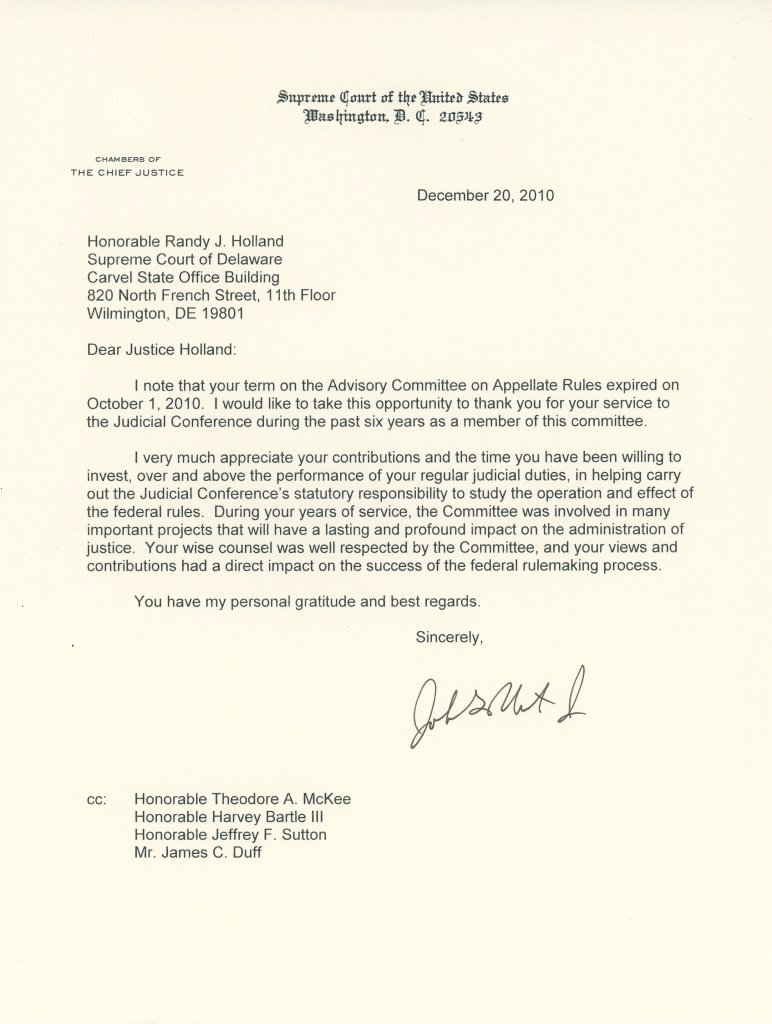 Categories: John Roberts
-
Subscribe
Subscribed
Have a WordPress.com account? Log in now.

